
The Architecture of Trust: Why Relationships Come First
Before you can engineer process or scale maturation, you have to build the relational foundation. Here's why trust is the load-bearing wall of every high-performing team.
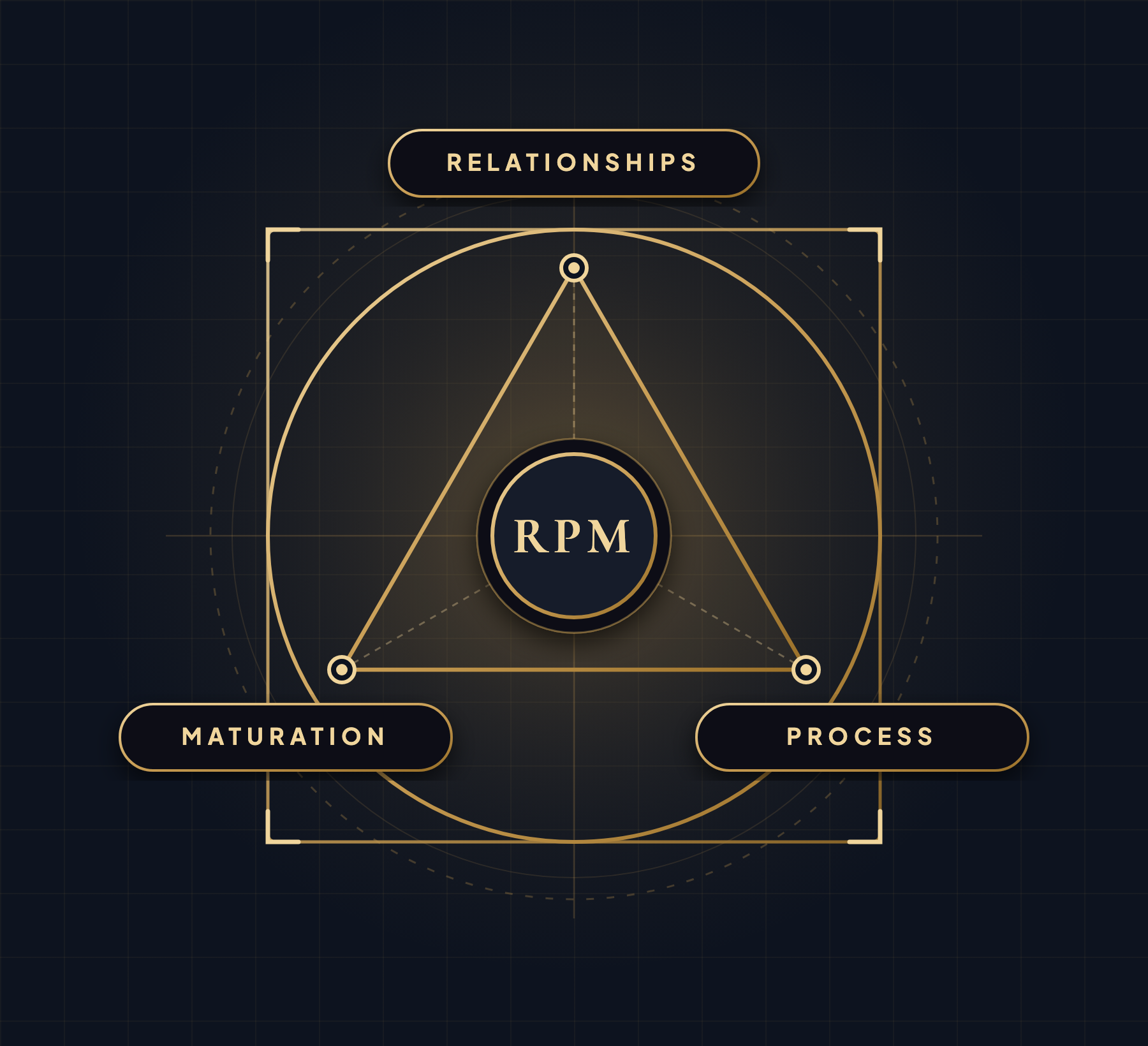
- Trust is the unseen load-bearing wall of every organization; Process and Maturation collapse without it.
- High-trust teams replace the defensive "Can we?" reflex with principle-centered "How can we?" ownership.
- Relational trust is not a vague feeling. It is engineered through 4 repeatable behaviors: Transparency, Accountability, Curiosity, and Consistency.
The Load-Bearing Wall
Great architecture begins with a foundation you cannot see. The same is true of great organizations.
Before a single KPI is written, before a single SOP is documented, before a single promotion is announced, there is a question every leadership team must answer honestly: Do we trust each other?
Not the surface-level, nodding-heads-in-a-meeting kind of trust. The kind where a supervisor can say “I got this wrong” without fear, where cross-functional teams default to “how can we?” instead of “can we?”, where feedback flows in every direction because the relationship can hold it.
- Defaults to “Can we even do this?”
- Nods politely in meetings, then resists privately
- Asks “Whose fault was it?”
- Hoards information across departments
- Defaults to “HOW can we make this work?”
- Surfaces hard truths early, without fear
- Asks “What did we learn?”
- Shares real numbers and real accountability
The Three Fractures
In my work across manufacturing, logistics, and corporate enterprises, I see the same three structural fractures again and again.
Relational Friction
Departments operating with politeness instead of trust. Nodding heads in meetings, private resistance after them.
Execution Gaps
Managers trapped firefighting without clear KPIs or documented SOPs. Reacting all week instead of coaching.
Stalled Maturation
High performers promoted into leadership without the behavioral tools or mentoring to scale themselves or others.
Can We vs. How Can We
Here is the part most consultants won’t tell you: you cannot fix process or maturation until you fix relationships. The deepest lever is a mindset shift, and it shows up first in the questions a team asks.
“Can we?” is a ceiling. It is a reflex born of self-protection, a way of testing whether it is safe to even try. “How can we?” is a door. It assumes the answer is yes and moves straight to the engineering. The first freezes a team; the second mobilizes one. The difference is not talent. The difference is trust.
What Trust Actually Looks Like
Trust is not a feeling. It is a set of repeatable behaviors.
Transparency
Sharing the real numbers, the real challenges, the real strategy. No hidden ledgers, no spin.
Accountability
Owning outcomes without deflecting blame. The buck stops, and it stops out loud.
Curiosity
Asking "what did we learn?" instead of "whose fault was it?" Curiosity is the engine of growth.
Consistency
Showing up the same way on the good days and the hard ones. Trust is built by repetition, not by gesture.
When those behaviors become cultural, process becomes possible. Maturation becomes inevitable.
The RPM Principle
This is why Relationships is Focus One in the RPM Framework, not because it’s the easiest, but because it’s the first. Process and Maturation are built on top of it. Skip it, and the whole structure collapses under its own weight.
A leader’s curiosity is in direct proportion to their growth, and what you invest in yourself reflects your results.
Start with trust. The rest is engineering.
How Strong Is Your Load-Bearing Wall?
Your relational foundation is the bottleneck. Start here before touching a single KPI or SOP. A Relationships-focused workshop plus DISC profiling will surface the fractures fast.
See this applied to your team
Book a complimentary 30-minute strategy call with Brian Littlehale and map your next 90 days of leadership momentum.
Keep reading
From Firefighting to Framework-Building: The Process Pillar
If your managers spend 80% of their week reacting to crises, the problem isn't effort - it's architecture. Here's how to translate strategy into repeatable daily execution.
ReadThe Maturation Gap: Why Your Best Performers Aren't Ready to Lead
Promoting your top individual contributor into a leadership role without preparation is the most expensive mistake most organizations make. Here's how to close the gap.
ReadDISC, Hogan & 360°: Which Assessment Is Right for Your Team?
Three of the most powerful behavioral diagnostics in leadership development - and how to know which one your organization actually needs.
Read